
Pinellas Regional Juvenile Detention Center Overview
The Pinellas Regional Juvenile Detention Center is operated by the Florida Department of Juvenile Justice, known as the DJJ, in its Central region. It is a secure detention center, which means it holds youth in custody rather than housing them in a long-term residential program. The DJJ says detention centers hold young people who are awaiting court dates or placement in a residential facility. The center is regional. It serves four counties, not just one, taking in youth from Hardee, Highlands, Pinellas, and Polk.
This is a key point to get right. The facility is not a county jail and not a state prison. Adults are never held here. The people in custody are minors handled under Florida's juvenile justice system, which is separate from the adult courts and the adult jail. Because of that, the kind of public online search that works for the adult Pinellas County Jail does not exist for this center. Custody and records for these youth are protected, so the information available to the public is limited by design.
Pinellas Regional Juvenile Detention Center Capacity
Capacity figures for this facility are limited in official sources. The DJJ detention-center table does not publish a bed count for the center. A DJJ Prison Rape Elimination Act audit reference indicates a designed capacity of 95 beds. That single sourced number is shown below, with the caveat that the main DJJ facility listing does not confirm it.
Daily population counts for this center are not posted publicly the way an adult jail reports its average daily population. The 95-bed figure is a design number from an audit reference, not a live headcount, so treat it as the planned size of the building rather than the number of youth held on any given day.
How to Get Information About a Youth Held Here
There is no public roster for this facility. Juvenile records and custody information are confidential and restricted under Florida law, so a parent or guardian cannot simply type a name into a public website and see a juvenile booking. Anyone trying to confirm whether a young person is in custody, or to learn court dates and placement, has to go through the proper restricted channels rather than an adult-style search.
- Contact the Florida Department of Juvenile Justice or the detention center directly using the phone number in the contact section below.
- Work through the juvenile court handling the case, since the court controls hearing dates and placement decisions.
- For general information about DJJ detention, see the state's DJJ detention-center list.
- If a parent or guardian, be ready to verify your identity and relationship, because access to juvenile information is limited to authorized people.
One exception matters here. A juvenile who is charged or adjudicated as an adult may be held at the adult Pinellas County Jail instead of a juvenile center, and an adult-certified youth in the adult jail can appear on the sheriff's public roster. That is the only situation where the public adult roster would apply, and it covers the adult jail, not this DJJ facility.
Important: Do not expect to find a youth held at this center on any public inmate roster, because Florida law keeps juvenile detention and records confidential and limited to authorized people.
Pinellas Regional Juvenile Detention Center Address and Contact
The center is in Clearwater, in the same broad 49th Street and Ulmerton public-safety corridor as the other detention sites in the county. The phone and fax below are the published DJJ contacts for the facility. Calling the center or the DJJ is the right first step for custody questions, since there is no online lookup.
Pinellas Regional Juvenile Detention Center
5255 140th Avenue North
Clearwater, FL 33760
(727) 538-7100
Fax: (727) 538-7318 (Florida DJJ, Central region)
The Florida Department of Juvenile Justice operates the center and lists it among the state's secure detention sites. Because the facility serves Hardee, Highlands, Pinellas, and Polk counties, a youth held here may have a case in a court outside Pinellas County, so the handling court is the place to confirm hearing dates.
Visiting a Youth at the Detention Center
Visitation at a DJJ detention center is set by the state juvenile agency and the individual facility, not by the county sheriff's jail rules. The sheriff's adult video-visit system has nothing to do with this center. Specific visiting days, hours, approved-visitor rules, and any video options are managed by the DJJ and should be confirmed directly with the center before any visit. To avoid stating a schedule that is not documented, the items below show what to confirm rather than fixed times.
| Item | Where to Confirm |
|---|---|
| Visiting days and hours | Set by DJJ; confirm with the center at (727) 538-7100 |
| Approved visitor list | Set by DJJ; verify who may visit and what ID is needed |
| Phone or video contact | Set by DJJ; confirm with the facility |
| Identity and relationship | Authorized people only, due to juvenile confidentiality |
Note: Visiting rules at a juvenile detention center are set by the state and can change, so call the facility to confirm days, hours, and who is allowed to visit before you travel.
Mail, Phone, and Money at the Detention Center
Mail, phone access, and any way to add money to a youth's account at a juvenile detention center are governed by the Florida Department of Juvenile Justice and the center's own procedures. These are not the same vendors or addresses the adult Pinellas County Jail uses. The research available does not document a public mailing format, phone vendor, or money-deposit system for this facility, so rather than invent one, the right move is to confirm each detail directly with the center.
When you call the facility, ask how to address a letter to a youth, whether and how the youth can make calls, and whether the center accepts any funds for the youth. Staff can explain the current rules and any forms or approvals needed. Because juvenile programs differ from adult jail operations, do not assume the adult jail's Smart Communications, ConnectNetwork, or iCare systems apply here.
How Youth Are Detained at This Facility
Youth are placed in secure detention under Florida's juvenile law rather than booked the way an adult arrestee is booked into a county jail. The DJJ says its detention centers hold young people while they await court dates or placement in a residential program. That makes the center a holding point in the juvenile court process, not a long-term sentence facility.
The decision to detain a youth, and for how long, runs through the juvenile court and DJJ screening rather than a jail bond counter. Some youth are released to a parent or guardian, some are held pending a hearing, and some move on to a residential placement after the court decides. Because the path is set by the court and the state agency, the most reliable updates on a specific youth come from those offices, not from a public records search.
About the Pinellas Regional Juvenile Detention Center
The center is one of the Florida Department of Juvenile Justice secure detention facilities listed for the state's Central region. It serves Hardee, Highlands, Pinellas, and Polk counties, which is why it carries the word regional in its name. The DJJ publishes compliance and program reviews for its detention centers, and the agency's detention-center list is the public starting point for general information about how these facilities operate. The list does not act as an inmate roster and does not show individual youth.
The biggest thing to understand about this facility is what it is not. It is not part of the adult Pinellas County inmate population system, it does not appear on the sheriff's Who's in Jail roster, and its records are not open the way adult booking records are. A youth who has been charged or adjudicated as an adult may instead be held at the adult county jail, which has its own public roster, but that is a different facility and a different process. For the general state context, the DJJ detention page below is the right reference.
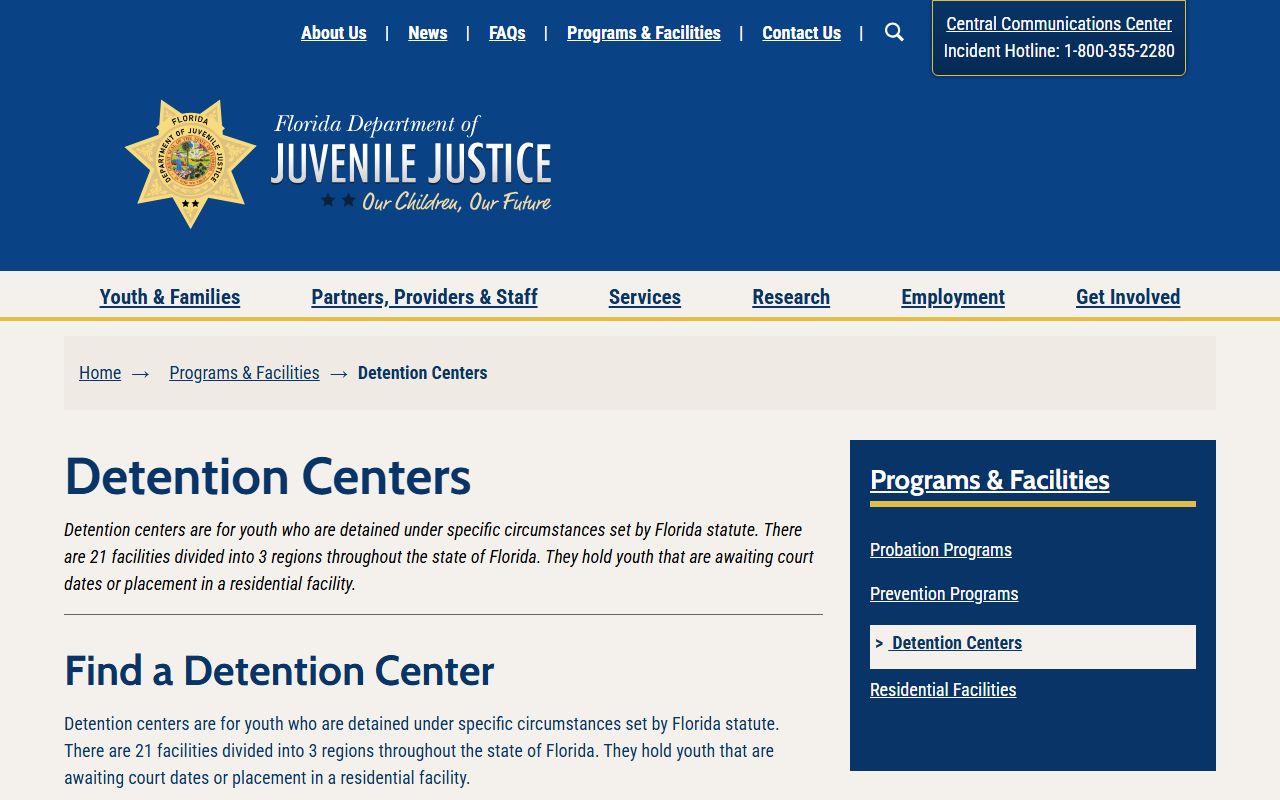
That state list shows where DJJ detention centers sit and confirms this facility is a secure juvenile site rather than an adult jail.
Note: Because juvenile custody is confidential, confirm whether a youth is held here and any visit details directly with the facility or the court before traveling.