
Pinellas County Court Records After a Jail Arrest
Once someone is arrested and booked into the Pinellas County Jail, the record starts on the jail side. The Pinellas County Sheriff's Office holds the booking, the initial charges, and the bond detail. The court record comes next. The Office of the State Attorney, Sixth Judicial Circuit reviews the arrest and decides whether to file charges. State Attorney Bruce Bartlett leads that office, which serves both Pinellas and Pasco counties and prosecutes cases for the State of Florida. When the prosecutor files, a case opens with the Pinellas County Clerk of the Circuit Court. That filing is what turns an arrest into court records.
Florida moves fast in the early hours. A person who is not released first generally gets a first appearance within 24 hours of arrest under Florida Rule of Criminal Procedure 3.130. A judge reviews the charges, sets bond, and notes counsel. The booking record and the court record line up at this point, but they are not the same file. The jail roster shows custody, booking charges, and bond. The court record shows the charges the prosecutor actually filed and how the case moves. For custody and booking detail, the jail inmate records page covers the roster, and booking photos are handled on the jail roster mugshots page.
How to Find Pinellas County Court Records After an Arrest
The court case index for the county is the Pinellas Clerk Court Records Public View. It is free, and most documents need no account. The portal covers felony, misdemeanor, criminal traffic, and other case types the clerk maintains. Booking and arrest detail live on the sheriff's roster, but the filed charges and the case history live here in the court record. A captcha appears at times, and the clerk warns it can log a user out now and then.
- Open the Pinellas Clerk Court Records Public View portal and read the clerk records guide if you need search tips.
- Search by defendant name, or switch to the Case, Attorney, or Court Calendar tab to use a case number instead.
- Open the case to see Parties, Charge Details, Hearings, Events & Documents, Financials, and Bonds.
- Read each charge for its statute, level, and current status, and use View On Request for documents that are not yet visible.
Two limits are worth knowing. Results stop at the first 500 records, so a common name needs a date of birth or a date range to trim the list. Confidential cases show only the word CONFIDENTIAL with no link. The clerk's criminal court page explains which case types the office files and keeps. For records that span the state rather than one county, a separate statewide path applies, covered further down.
A look at the portal itself helps before the first search, shown on the Court Records Public View landing page.
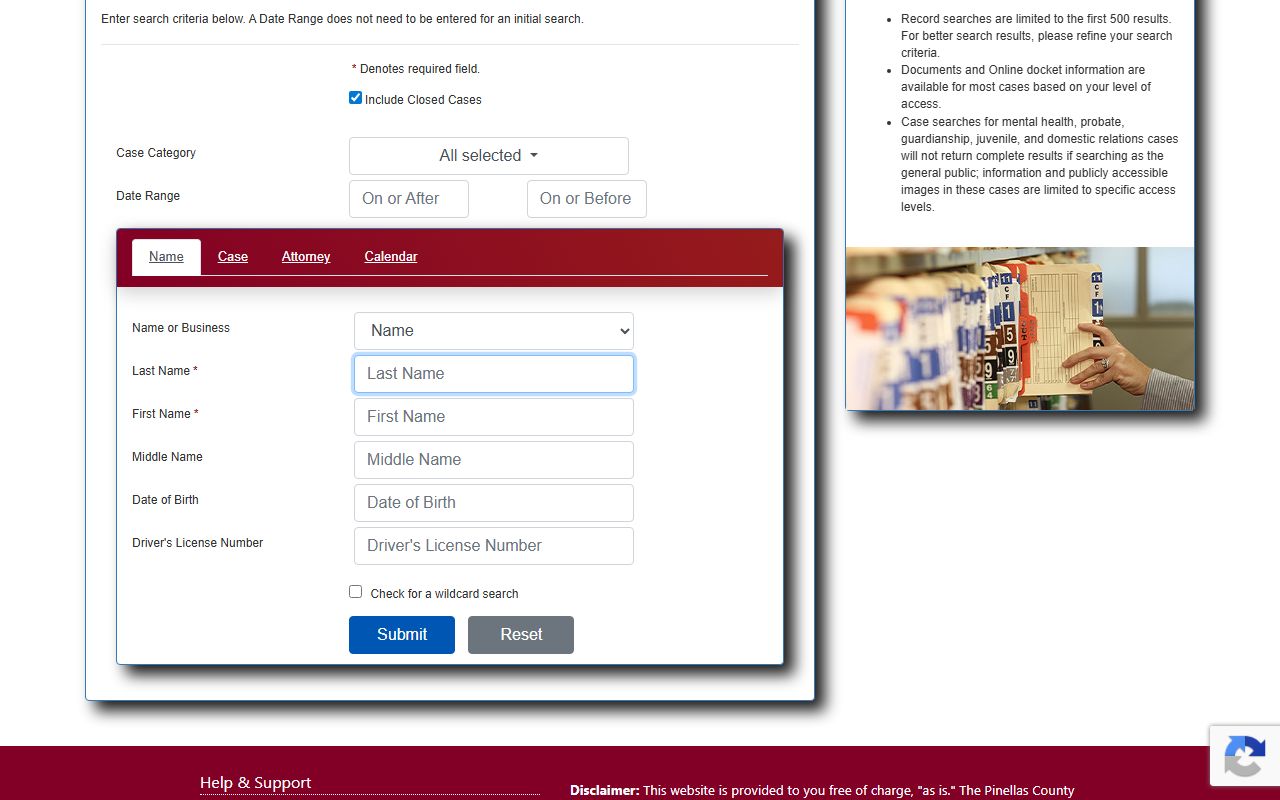
The portal opens to a search panel with tabs for Name, Case, Attorney, and Court Calendar, which is where every court record lookup after an arrest begins.
Court Records Public View Search Fields
The Public View portal accepts more than a name. A short list of the fields it exposes shows how to aim a search and how to widen or narrow it. The clerk's own guide walks through the same fields with screenshots, and a quick look at that guide makes the search panel easier to read.
The clerk guide and its instructions appear on the View Records help page.
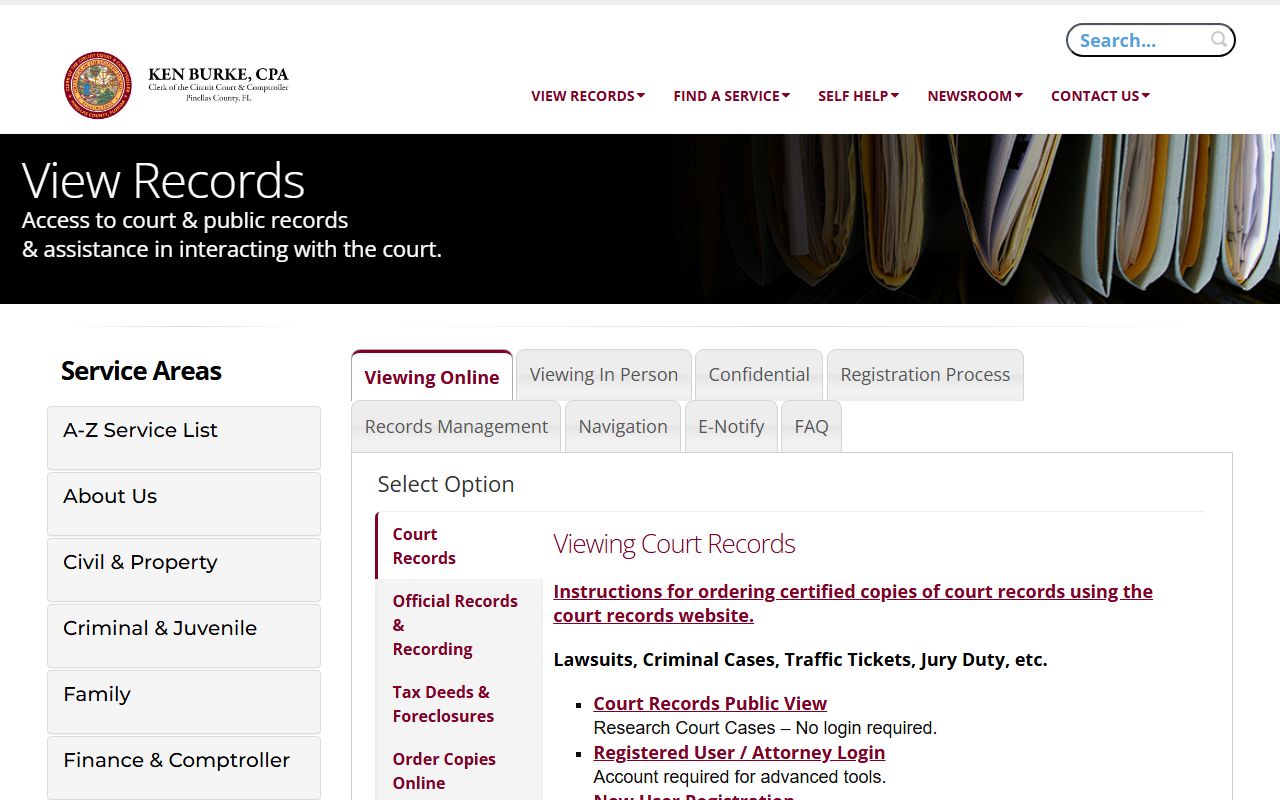
The guide confirms the search modes and the 500-record cap, which matters most when a last name is common.
| Field Label | Type | Required | Notes |
|---|---|---|---|
| Case Category | Dropdown | No | Felony, Misdemeanor, Criminal Traffic, Juvenile, and more. |
| Include Closed Cases | Checkbox | No | Adds closed cases to the result list. |
| Last Name | Text | For name search | Wildcard allowed with at least 3 characters plus an asterisk. |
| First Name | Text | For name search | Narrows a common last name. |
| Date of Birth | Date | No | Trims criminal and traffic defendant results. |
| Case Number | Text | Under Case tab | Format YY-XX-999999; dashes and leading zeroes optional. |
| Date Range | Date range | No | Filed-date searches return a maximum of 500 cases. |
Note: a confidential case shows only as CONFIDENTIAL with no clickable link, which signals a sealed or restricted file rather than a missing record.
How Charges Get Filed After an Arrest: Complaint, Information, and Indictment
The arrest comes first, then booking at the jail. The court charge record begins only when a charging document is filed. A charging document is the formal paper that accuses a person of a crime and starts the case. Florida uses three main kinds. A complaint is an early sworn accusation, often from the arresting officer, and is common for lower-level matters. An information is filed by the prosecutor and is the usual route for most felonies and misdemeanors in the Sixth Circuit. An indictment comes from a grand jury, a panel of citizens who decide whether the evidence supports a serious charge, and Florida reserves it for capital crimes. Florida Rule of Criminal Procedure 3.140 sets out these forms.
| Complaint | Information | Indictment | |
|---|---|---|---|
| Filed By | Officer / Prosecutor | Prosecutor | Grand Jury |
| Common For | Misdemeanors | Many felonies | Capital felonies |
| Starts | The case | The case | The case |
The prosecutor is not bound by the booking charges. Under Florida Statute § 27.02, the State Attorney appears in the circuit and county courts and prosecutes cases for the State. The office reviews each arrest to decide whether the evidence warrants a charge. It may file the booking charge, file a different charge, add or drop counts, or decline to file at all. The court record reflects the prosecutor's decision, not the arrest paperwork.
Charge Status in the Court Record After an Arrest
Charges shift as a case moves. The booking charges on the jail roster often differ from what the prosecutor finally files, and the filed charges can change again during the case. A charge may be amended, reduced, added, or dropped. Reading the status field tells you where each count stands. The terms below appear in Florida criminal case records and explain what each label means.
| Status | What It Means |
|---|---|
| Pending / Awaiting Trial | The charge is filed and active, waiting on hearings, a plea, or trial. No outcome yet. |
| Amended / Reduced | The prosecutor changed the charge, often to a lower level, after reviewing the case. |
| Dismissed | The court dropped the charge, ending it without a conviction. |
| Nolle Prosequi | A Latin term meaning the prosecutor chose not to pursue the charge, so it is withdrawn. |
Case detail in the Public View portal lists each charge under Charge Details and tracks activity under Hearings and Events & Documents. Felonies, the most serious offenses, generally carry more than a year of possible prison time and are handled in Circuit Court. Misdemeanors are handled in County Court. A criminal traffic charge such as DUI requires a court appearance and may bring fines, probation, or jail.
Bond and First Appearance After an Arrest
First appearance sets the early terms of release. A judge reviews the charges, decides whether bond applies, and sets the amount or conditions. Bond is money or a promise that secures a person's return to court. Some people walk out on their own recognizance. Others must post cash or use a bonding agent. And some are held with no bond at all when a hold or serious charge blocks release. The table below sorts the main bond types used at the Pinellas County Jail.
| Bond Type | How It Works |
|---|---|
| Cash Bond | The full amount is paid in cash or by approved check or money order payable to the Clerk of the Circuit Court. Valid photo ID required. |
| Surety Bond | A registered bonding agent posts the bond for a fee. The sheriff does not recommend any agent. |
| PR / Recognizance | Release on a written promise to appear, with no money posted, under conditions the court sets. |
| No-Bond Hold | No release is allowed, often because of a detainer or a hold from another court or agency. |
The sheriff accepts card payments through GovPayNow, also branded AllPaid, up to $2,500 per charge with a vendor fee. Before paying, have the defendant's name, docket number, and case number ready, all of which appear in the jail roster or the clerk record. A detainer is a custody flag from another agency that can keep a person locked up even after a bond is posted. The jail's bond and inmate records line is (727) 464-6415. The sheriff's Post Bond page lists the current methods.
Warrants That Lead to an Arrest
Many bookings start with a warrant. A warrant is a court order that authorizes an arrest, and serving one produces a new jail booking that can show in jail records before the court docket updates. The Pinellas County Sheriff's Office does not run its own public warrant database. Its warrants page points people to the Florida Department of Law Enforcement instead.
The state tool is the FDLE Wanted Persons Search, which covers wanted-person records entered by Florida agencies statewide. One caution matters here. The sheriff warns that the FDLE tool does not search local Pinellas warrants, such as parking-ticket warrants, even though it searches statewide warrants. For a court case or a local warrant the FDLE tool does not show, the Pinellas Clerk can help at (727) 464-7000. The sheriff's non-emergency line is (727) 582-6200.
Statewide Criminal History and Court Records
County court records cover cases filed in Pinellas. A statewide criminal history covers a person across all of Florida. The Florida Department of Law Enforcement runs that statewide check, authorized under Florida Statute § 943.053, which lets FDLE share state criminal-history data under set rules and fees. A public FDLE criminal-history check costs $24.00 plus a $1.00 credit-card processing fee.
The clerk also offers a Pinellas-only record search by name for a fee, with copies costing extra. For prosecutor records, the State Attorney maintains its own public-records channel through the Sixth Judicial Circuit State Attorney site. Florida Statute § 119.07 is the open-records law that makes most of these records available, while Florida Statute § 119.0714 applies the exemption and confidentiality rules to court files specifically.
Charges vs. Convictions in Court Records
An arrest and a filed charge are not a conviction. A charge is an accusation. A conviction is the result, reached only by a plea or a verdict. Many charges never become convictions. They get reduced, dismissed, or dropped through nolle prosequi. Reading a court record means knowing which stage a case sits in.
| Charge | Conviction | |
|---|---|---|
| Stage | Accusation | Verdict or plea |
| Burden of Proof | Probable cause | Beyond reasonable doubt |
| Public Record | Yes | Yes |
Note: the jail roster shows booking charges and is not a final criminal record, so the clerk's court file is where the actual outcome of each charge is confirmed.
Sealed vs. Expunged Court Records After an Arrest
Florida lets some people clear a record after an arrest. The two tools are sealing and expunction, and they are not the same. A sealed record is hidden from public view but still exists, with limited access for certain agencies. An expunged record is destroyed or treated as if it never existed, with access stripped to a very small set of users. Florida Statute § 943.0585 governs expunction, and Florida Statute § 943.059 governs sealing. Both run through a court order, and eligibility is narrow.
| Sealed | Expunged | |
|---|---|---|
| Visibility | Hidden from public | Destroyed / treated as never existed |
| Law Enforcement | Limited access | Very limited |
| Florida Statute | § 943.059 | § 943.0585 |
A dismissed charge or one ended by nolle prosequi may qualify for expunction, while certain completed cases may qualify for sealing. The filings go through the Pinellas Clerk, and a sealed or expunged case shows in the Public View portal as CONFIDENTIAL or not at all.
Background Check Considerations
There is a real gap between a casual court record lookup and a formal background check. Reading public court records for personal knowledge is one thing. Using records to decide on a job, a loan, an apartment, or insurance is governed by the federal Fair Credit Reporting Act, the FCRA. That law applies to consumer reporting agencies, which are screening companies bound by strict accuracy and notice rules. The free clerk portal and statewide FDLE checks are public-records tools, not FCRA-regulated reports.
Important: This is a free public reference and is not a consumer reporting agency under the FCRA, so nothing here may be used for credit, employment, housing, or insurance decisions.
Restricted Court Records After an Arrest in Pinellas County
Not every court record after an arrest is open. Florida Rule of General Practice and Judicial Administration 2.420 makes judicial records public unless a rule, statute, or court order seals them. Juvenile delinquency and dependency files are confidential and generally are not online, and a request needs identification and proper access. Sealed and expunged cases drop out of public view. Florida Statute § 119.0714 and the related exemptions can require parts of a court file to be redacted, such as victim or protected personal detail.
When a record does not appear, the cause is usually confidentiality, not a missing file. Older paper records may need a call to the clerk at (727) 464-7000. For prosecutor files, the State Attorney handles its own public-records requests through the Sixth Judicial Circuit office. Sorting the jail booking record from the court charge record keeps each request aimed at the right office, which is the fastest way to find what an arrest left behind.